.jpg)

Why this guide exists
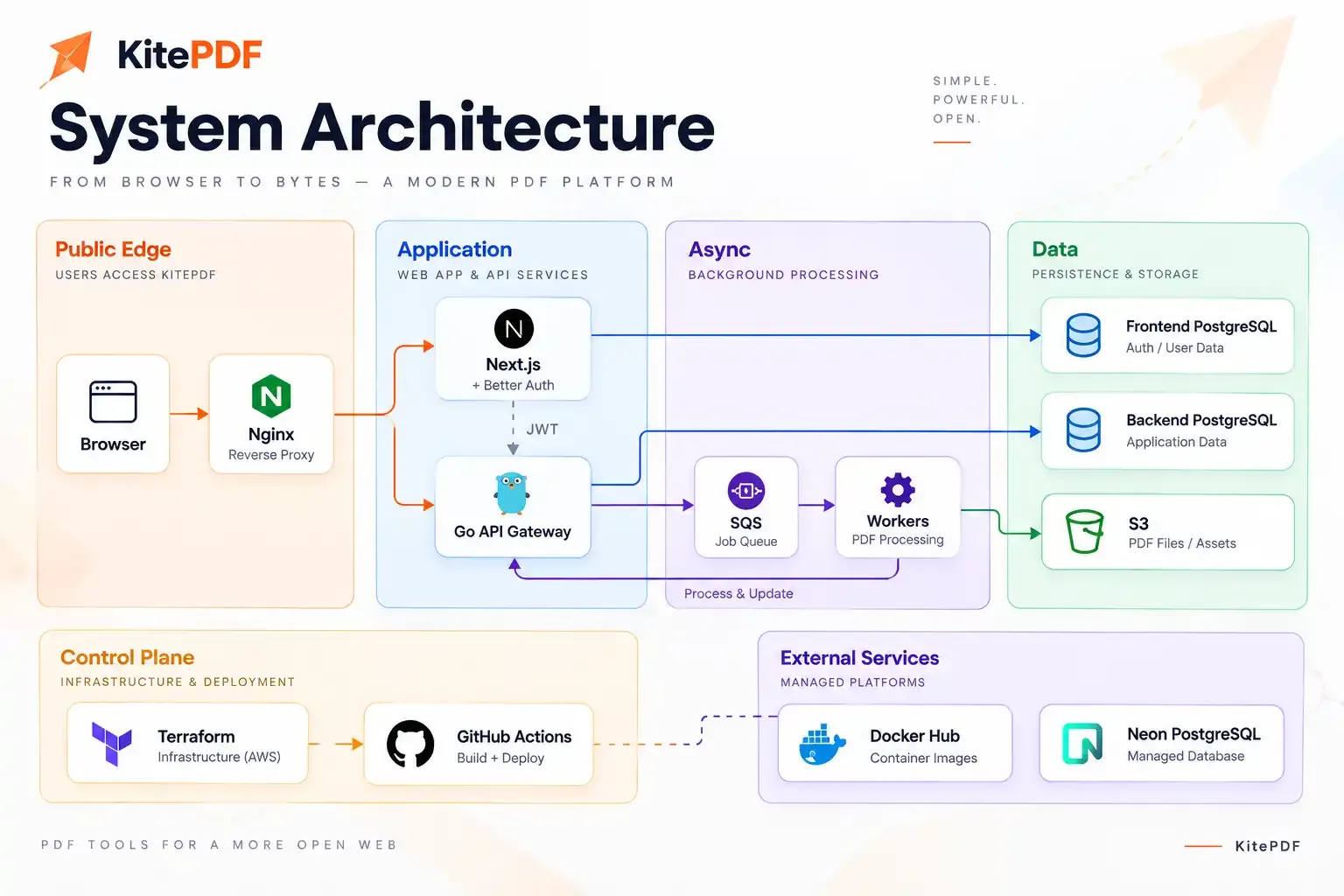
This is not a README pasted into Benchlog. It explains the design problems KitePDF solves, the boundaries between components, and why the stack looks the way it does. Deployment commands and env file names live in later parts; here we focus on mental models you can reuse when you extend the product.
The problem we are solving
KitePDF turns PDF work into durable, billable jobs: upload once, process asynchronously, download when ready. That shape forces three non-negotiables: a public edge that stays thin, a policy layer that owns identity and credits, and stateless workers that can scale independently. Everything in the architecture serves one of those three.
Trust zones at a glance
| Zone | Who calls it | What must never happen |
|---|---|---|
| Public edge | Browsers | Exposing api-gateway or worker ports directly on the internet |
| Application plane | Browsers (UI + JWT) | Workers or anonymous clients mutating billing state without policy checks |
| Async plane | SQS consumers | Workers trusting user cookies; they use internal secrets only |
| Internal hooks | Frontend server, workers | Any route without X-Internal-Secret on /internal/* |
Authentication: design choice
We split identity into two stores on purpose. Better Auth in the Next.js app owns login sessions, email verification, 2FA, and admin plugins against the frontend database. The Go api-gateway never sees passwords—it only accepts cryptographically verifiable JWTs and maps them to rows in the backend database. That separation keeps the high-churn auth surface in one codebase while the job and credit domain stays in Go.
Better Auth on the frontend
Better Auth handles email/password, verification, password reset, bearer support, optional two-factor, and admin capabilities. User records live in frontend Postgres. On signup (or guest conversion), a database hook calls the api-gateway internal API to create or link a backend user keyed by auth_id—the same identifier embedded in JWTs.
- Frontend DB: sessions, accounts, verification tokens, Better Auth tables.
- Backend DB: users.id used in jobs and credits; users.auth_id links to IdP user id.
- Failed backend sync on signup rolls back the frontend user to avoid split-brain accounts.
JWT issuance and JWKS verification
The Better Auth JWT plugin signs access tokens (payload includes id, email, name, role). The browser obtains a fresh JWT via getSession—the Set-Auth-Jwt response header—and sends Authorization: Bearer on api-gateway requests. The gateway does not share a static secret with the frontend; it bootstraps a JWKS client (AUTH_JWKS_URL, typically /api/auth/jwks on the app origin) and validates signature, issuer, and audience on every protected request.
Guests vs members
Anonymous users can still run a subset of tools. POST /guest/session creates a backend anonymous user; a signed httpOnly cookie (and optional X-Guest-Token) proves guest identity on flex routes. Flex middleware tries JWT first (AuthenticateJWTOptional), then guest cookie (AuthenticateGuest), then RequirePrincipal ensures someone is present. Member-only routes stack RequireMemberJWT with RejectAnonymous so dashboards, purchases, and paid tools require a real account.
Authorization: what happens after auth
Authentication answers who is calling. Authorization answers what they may do. KitePDF layers policy in middleware rather than scattering checks in handlers.
| Layer | Mechanism | Design intent |
|---|---|---|
| Tool access | RequireCredits per tool | Atomic balance check + deduction before handler runs; guests blocked on paid tools |
| Plan limits | User loaded with subscription plan on JWT resolve | One JOIN per request; rate limits and quotas read plan from context |
| Rate limits | Redis-backed limiter on uploads and jobs | Protect shared workers and storage from abuse |
| Admin | JWT role + RequireAdmin | Same JWKS path; admin role from token and backend user |
| Internal | X-Internal-Secret | Workers and trusted server hooks only; never exposed to browsers |
Route families (policy, not a path list)
- Public: health, share links, guest session create/revoke—no principal required.
- Flex: tools, files, job poll—JWT or guest, then credits and rate limits.
- Member: billing, library, notifications—JWT only, no anonymous principals.
- Admin: operations dashboard—JWT + admin role.
- Internal: job complete/fail, guest conversion—shared secret, no JWT.
Async processing architecture
Tool handlers are thin: validate input, enqueue work, return a job id. Workers own CPU and IO-heavy PDF operations. The gateway remains the system of record for job state; workers report outcomes through internal callbacks. S3 holds bytes; the gateway issues short-lived presigned URLs so browsers never receive long-lived object credentials.
Queue routing by tool type (Node vs Python) is a scaling knob: add consumers per queue without forking the API. The pattern is identical; only the worker implementation changes.
Data ownership
Frontend Postgres holds auth and UX-adjacent state. Backend Postgres holds jobs, credits, files metadata, and anonymous users. Neon or local containers are deployment details; the split is logical. Redis supports rate limiting and ephemeral coordination. This boundary lets you patch auth plugins without migrating job history, and vice versa.
Deployment shapes as tradeoffs
| Shape | What you optimize for | Auth implication |
|---|---|---|
| Local dev | Fast feedback | JWKS URL points at local Next.js; same JWT flow as prod |
| Prod-localstack | Integration fidelity on one machine | nginx single host; cookies and JWT issuer must match public URL |
| EC2 + real AWS | Cost-controlled production | BETTER_AUTH_URL and AUTH_* env vars must align with public hostname |
What to read next
Part 3 (planned) walks local setup. Part 6+ will cover horizontal worker scaling and observability. Keep this page as the map: edge → policy (authn/authz) → queue → workers → storage.